 VIVE O
In the whole biblical narrative, few figures stir as much mystery as Melchizedek. He appears suddenly in Genesis 14, with no genealogy, no explained origin, no recorded ending — and then disappears from the pages of the Old Testament for almost a thousand years, taken up again only in Hebrews as a prophetic type of Christ.
But who was this man really? Why did Abraham show immediate reverence to this unknown priest-king? And what does his mysterious identity reveal about the divine plan unfolding from the earliest days of history?
The unexpected meeting in Genesis
The first record of Melchizedek comes in a context of war. Abraham had just rescued his nephew Lot from a coalition of Mesopotamian kings, leading 318 trained men in a daring military operation.
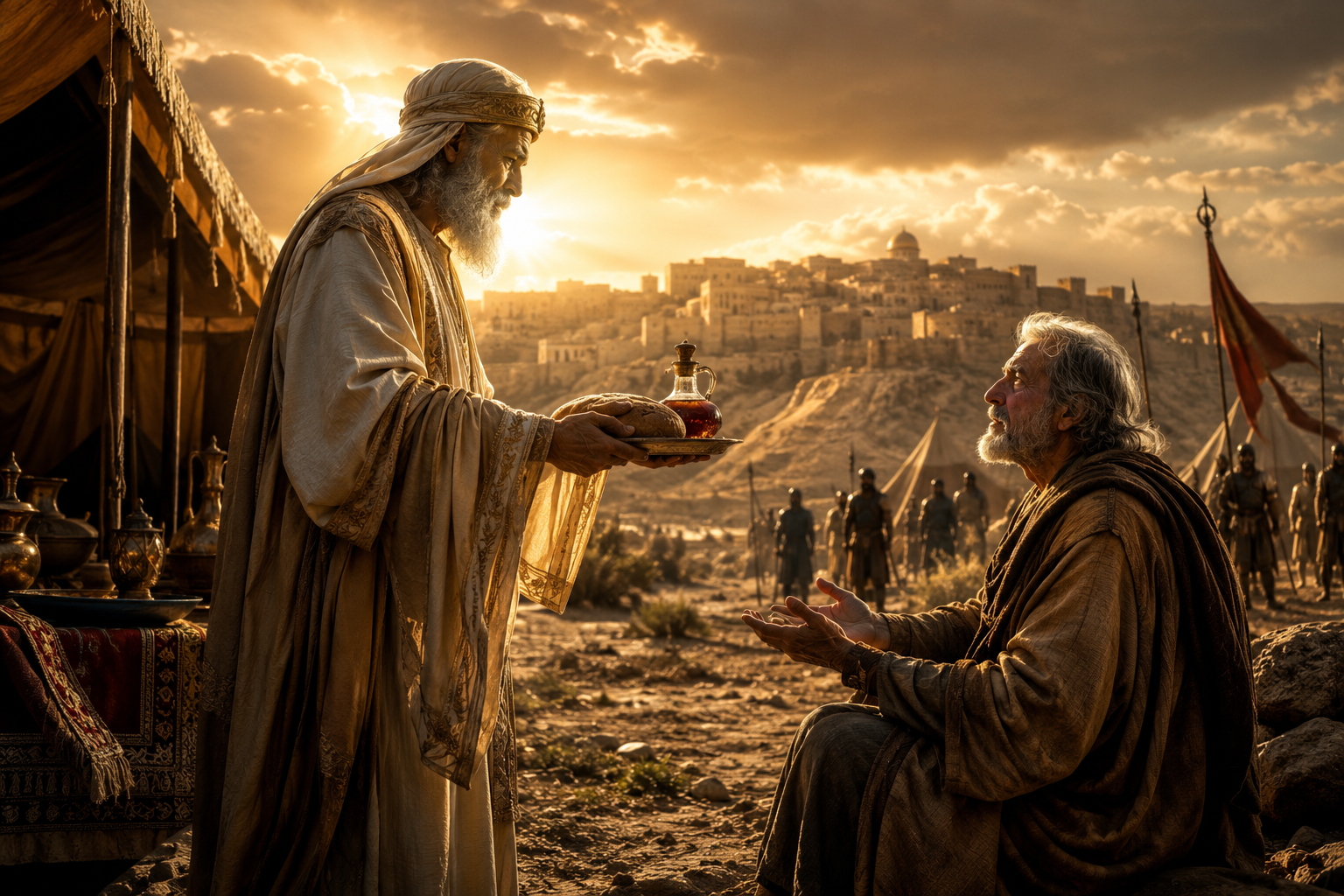
It is precisely in that moment of victory that the enigmatic figure appears:
“Melchizedek king of Salem brought out bread and wine. He was priest of God Most High. He blessed him, and said, ‘Blessed be Abram of God Most High, possessor of heaven and earth. Blessed be God Most High, who has delivered your enemies into your hand.’ Abram gave him a tenth of all.” (Genesis 14:18-20)
The biblical text shows Melchizedek holding two roles at once: king of Salem and priest of God Most High (El Elyon, in Hebrew). That combination was extremely rare in the ancient world, where royal and priestly functions were usually kept apart.
Salem, according to Jewish tradition and most scholars, refers to Jerusalem. Archaeological evidence suggests the city already existed in Abraham’s time (around 2000 BC), and it is mentioned in Egyptian execration texts of the nineteenth century BC.
But why did Abraham show such reverence to someone he was apparently meeting for the first time?
The mysterious title: priest of God Most High
The term “God Most High” (El Elyon) that Melchizedek uses is particularly significant. It was not a generic title for pagan deities, but a specific designation that Abraham immediately recognised as referring to the true God.
Abraham’s response is revealing. When the king of Sodom offers rewards from the spoils of war, Abraham declares:
“I have lifted up my hand to Yahweh, God Most High, possessor of heaven and earth” (Genesis 14:22)
Abraham uses exactly the same terminology as Melchizedek, suggesting both worshipped the same God. That implies Melchizedek had genuine knowledge of the Creator at a time when polytheism dominated the surrounding civilisations.
Scholars such as the archaeologist William Foxwell Albright argue that small enclaves of early monotheism may have persisted in certain regions, preserving traditions going back to Noah and his descendants.
But that raises an even deeper question: where did Melchizedek’s priesthood come from?
A priesthood without precedent
When we examine Melchizedek’s priesthood, we find unique features that defy the traditional categories of the Old Testament.
First, he did not belong to the Levitical line — which would only be established centuries later, through Moses. Second, there is no record of his ordination, genealogy or succession. Third, he combines royal and priestly authority in one person.
The Jewish historian Flavius Josephus, writing in the first century AD, records that Melchizedek was “the first priest of God” and that he “built the first temple” in Jerusalem. Although we should treat those claims as later tradition, they reflect Jewish recognition of the antiquity and legitimacy of his priesthood.
Intertestamental literature, including the Dead Sea Scrolls, also preserves traditions about Melchizedek, some portraying him as an eschatological figure who would return in the last days.
But the most surprising interpretation of Melchizedek would come centuries later, in the letter to the Hebrews.
The revelation in Hebrews: a type of Christ
The writer of Hebrews devotes considerable space to Melchizedek, developing a typology that connects this ancient priest-king directly to Jesus Christ:
“For this Melchizedek, king of Salem, priest of God Most High, who met Abraham returning from the slaughter of the kings and blessed him, to whom also Abraham divided a tenth part of all (being first, by interpretation, ‘king of righteousness’, and then also ‘king of Salem’, which means ‘king of peace’, without father, without mother, without genealogy, having neither beginning of days nor end of life, but made like the Son of God), remains a priest continually.” (Hebrews 7:1-3)
The author is not claiming Melchizedek had no literal parents, but that the biblical record intentionally omits that information in order to create a prophetic type. Unlike other biblical figures, whose genealogy is meticulously recorded, Melchizedek appears and disappears with no family context.
That absence of genealogy was significant for Jewish readers, who placed enormous value on priestly lines. The Levitical priesthood depended entirely on descent from Aaron, but Melchizedek represents a priesthood of a different order — based not on heredity but on direct divine appointment.
But why did that matter so much to the writer of Hebrews?
The superiority of Christ’s priesthood
The writer of Hebrews was addressing Jewish Christians who questioned whether Jesus, not being of the tribe of Levi, could really be a priest. The answer comes through Melchizedek:
“Here people who die receive tithes, but there one receives tithes of whom it is testified that he lives. We can say that through Abraham even Levi, who receives tithes, has paid tithes, for he was yet in the body of his father when Melchizedek met him.” (Hebrews 7:8-10)
The argument is brilliant: when Abraham paid tithes to Melchizedek, Levi (his descendant) had not yet been born, but was “in the body of his father”. So, symbolically, the Levitical priesthood paid tithes to the priesthood of Melchizedek, acknowledging its superiority.
This was not merely an abstract theological discussion; it had deep practical implications for early Christian identity.
Theories about Melchizedek’s identity
Across the centuries, scholars and theologians have developed various theories about who Melchizedek really was.
The theophany theory
Some early interpreters, including several church fathers, suggested Melchizedek was a pre-incarnate appearance of Christ. This theory, called theophany, rests on the description “having neither beginning of days nor end of life” in Hebrews.
Most modern scholars, however, reject that reading, arguing that Hebrews 7:3 says Melchizedek was “made like” the Son of God, not that he was the Son of God himself.
The converted Canaanite king theory
A more historical reading suggests Melchizedek was a local Canaanite king who, through divine revelation or family tradition, held on to knowledge of the true God in the middle of a polytheistic culture.
This theory has parallels in other biblical figures, such as Jethro (Moses’ father-in-law) and the queen of Sheba, who recognised the God of Israel despite their pagan backgrounds.
The line of Shem theory
Jewish tradition, preserved in the Talmud, identifies Melchizedek with Shem, son of Noah. On that theory, Shem would have lived long enough to meet Abraham and would have preserved worship of the true God from before the flood.
Although chronologically possible according to the biblical genealogies, that identification remains speculative.
Whatever his specific identity, what stays clear is the prophetic role Melchizedek plays in the biblical narrative.
The prophetic meaning of the symbols
Every element of the meeting between Melchizedek and Abraham carries symbolic meaning that connects to the work of Christ.
Bread and wine
Melchizedek brought “bread and wine” to Abraham. Centuries later, Jesus would institute the Lord’s Supper using exactly those same elements, declaring them symbols of his body and blood.
While we should be careful not to force typologies, the connection is striking and was recognised by early church fathers such as Justin Martyr and Cyprian.
The tithe
Abraham’s payment of the tithe sets a precedent of recognising spiritual authority. That voluntary act — predating the Mosaic Law — demonstrates a spiritual principle that transcends particular religious systems.
The blessing
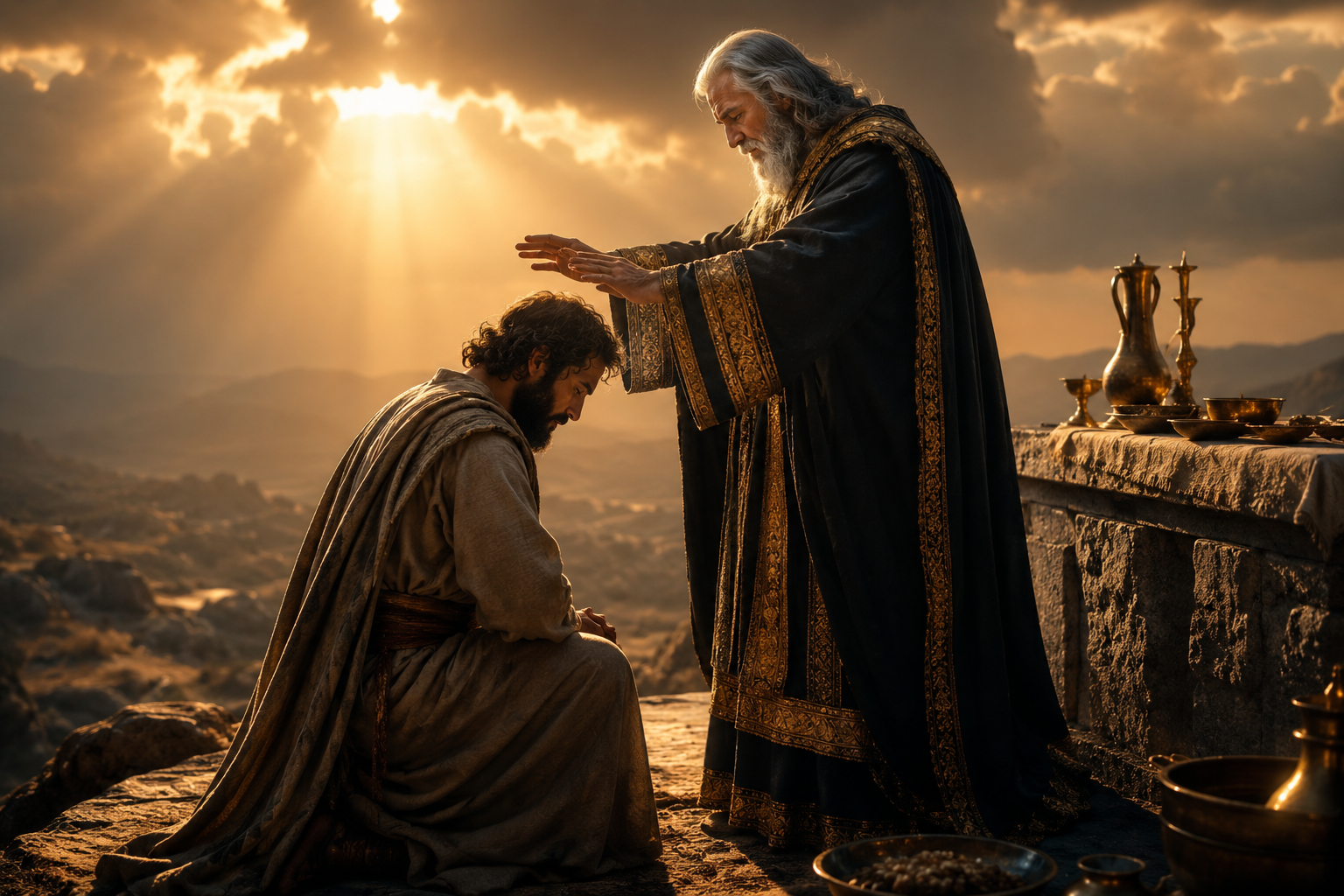
Melchizedek blesses Abraham, not the other way round. According to Hebrews 7:7, “without any dispute, the lesser is blessed by the greater”. That establishes Melchizedek’s spiritual superiority over Abraham himself.
But how do these ancient truths connect with our faith today?
Implications for Christian faith
The study of Melchizedek sheds light on fundamental aspects of Christ’s work that might otherwise go unnoticed.
First, it shows that the plan of salvation did not begin with the Mosaic Law, but was part of an eternal purpose predating every human religious system. Melchizedek represents a priestly order that exists “according to the power of an endless life” (Hebrews 7:16), not according to temporal regulations.
Second, it reveals that God always had a people who genuinely worshipped him, even in the midst of spiritual darkness. Melchizedek’s existence in Abraham’s day suggests divine truth was never entirely extinguished from the earth.
Third, it prefigures the unique nature of Christ’s priesthood, which combines royal and priestly authority, offering a definitive sacrifice that transcends the temporary Levitical system.
Scripture’s silence about Melchizedek’s end points to the eternity of Christ’s priesthood, who “has his priesthood unchangeable” and is able to “save to the uttermost those who draw near to God through him” (Hebrews 7:24-25).
Conclusion: the mystery that lights up the truth
Melchizedek remains one of the most enigmatic figures in the Bible, but his mystery serves a divine purpose. Emerging from the shadows of history with no genealogy or human credentials, he points to spiritual realities that transcend our earthly categories.
His meeting with Abraham was not accidental, but part of a carefully orchestrated design that prefigured the coming of the true Priest-King. In Jesus Christ we find not just a type or a shadow, but the full reality of what Melchizedek represented: an eternal priest, a righteous king, a perfect mediator between God and humanity.
The story of Melchizedek reminds us that God’s ways often defy our expectations, and that his work of redemption unfolds through divine encounters that connect past, present and eternity.
The Great Story — 7 free devotionals
If this subject touched you, I put together a free devotional with the most important passages to deepen your Bible reading.