
 VIVE O
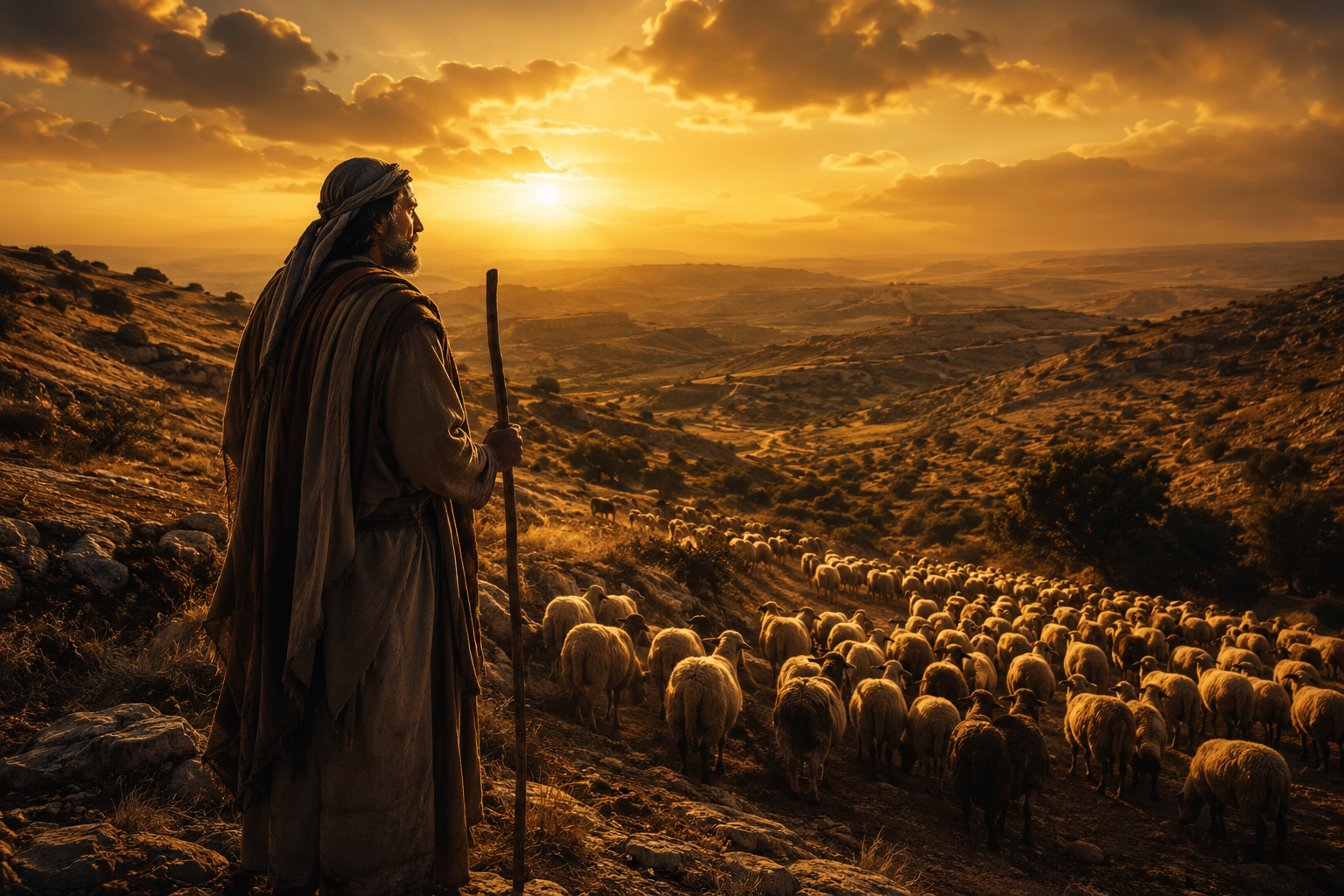
When we think of Psalm 23, the romantic image comes straight to mind: sheep grazing in green fields under the care of a gentle shepherd. But does that modern picture really capture what David had in mind when he wrote those words almost three thousand years ago?
Archaeological evidence and historical records from the ancient Near East reveal that shepherding in the Israel of biblical times was far more complex and dangerous than we imagine. A shepherd’s work involved life and death, protection against fierce predators and total responsibility for the flock’s wellbeing.
In this investigation we will uncover the real context behind each verse of Psalm 23, discovering how David’s actual experience as a shepherd shaped one of the most comforting passages in the Bible — and what that means for our understanding of divine provision, guidance and protection.
The shepherd in ancient Israel: a high-risk profession
Archaeological digs at Tell es-Safi, the ancient Philistine city of Gath, uncovered remains of lions and bears that lived in the region of Judea during the Old Testament period. Those finds confirm the biblical account that David, as a young man, faced such beasts to protect his flock.
According to contemporary Assyrian records, shepherds in the region carried a rod — a club about 60 centimetres long used to discipline the sheep — and a staff — a long stick with a hook at the end to rescue animals that fell into ravines or got lost in difficult terrain.
The work demanded intimate knowledge of the land, of the water sources and of the safe paths through rocky valleys. An inexperienced shepherd could lead an entire flock to its death.
But how does that brutal reality connect with the poetic language of Psalm 23?
‘The Lord is my shepherd’: authority and total dependence
When David declares ‘The Lord is my shepherd’, he is not making a superficial comparison. The Hebrew text uses the word ‘ro’eh’, which implies not only care but absolute authority over the life and fate of the flock.
Yahweh is my shepherd; I shall lack nothing. (Psalm 23:1)
Egyptian papyri from the period show that shepherds were legally responsible for every animal in their care. If a sheep was lost or attacked by predators, the shepherd had to answer to the flock’s owners.
That total responsibility explains the confidence in the second half of the verse: ‘I shall lack nothing’. It is not a promise of luxury, but the guarantee that every essential need will be met by someone who has taken personal responsibility for his sheep’s wellbeing.
But what exactly were those ‘essential needs’ in the context of ancient shepherding?
Provision in arid land
Studies from the Institute of Archaeology at the Hebrew University found that the region of Judea, where David shepherded, received only 200-400 mm of rain a year. During the dry months, from May to September, finding green pasture was a matter of life or death for the flock.
He makes me lie down in green pastures. He leads me beside still waters. (Psalm 23:2)
The phrase ‘green pastures’ in Hebrew is ‘ne’ot deshe’ — literally ‘dwellings of fresh grass’. That suggests not only food, but safe resting places where the sheep could chew the cud without fear of predators.
‘Still waters’ also carries a technical meaning. Sheep will not drink from rushing streams — they can drown easily. Experienced shepherds knew the wells and springs where the water ran calmly, letting the animals drink safely.
Restoring the soul: more than physical rest
Verse 3 introduces a concept that goes beyond the sheep’s physical needs:
He restores my soul. He guides me in the paths of righteousness for his name’s sake. (Psalm 23:3)
The Hebrew word ‘nephesh’, translated ‘soul’, refers to the whole being — physical, emotional and spiritual. But why does David connect that restoration with ‘paths of righteousness’?
Cuneiform texts from Mesopotamia show that ‘paths of righteousness’ was a technical expression used to describe safe, legally established routes. Shepherds had right of way along certain paths, but straying from them could cause territorial conflict or lead the flock into dangerous ground.
When David speaks of being led ‘for his name’s sake’, he recognises that the shepherd’s reputation is at stake. A shepherd who lost sheep through negligence or a poor choice of route would lose his credibility.
But what happened when those safe paths ran through genuinely dangerous territory?
The valley of the shadow of death: real geography or metaphor?
The most famous verse of the psalm may have a concrete geographical basis:
Even though I walk through the valley of the shadow of death, I will fear no evil, for you are with me. Your rod and your staff, they comfort me. (Psalm 23:4)
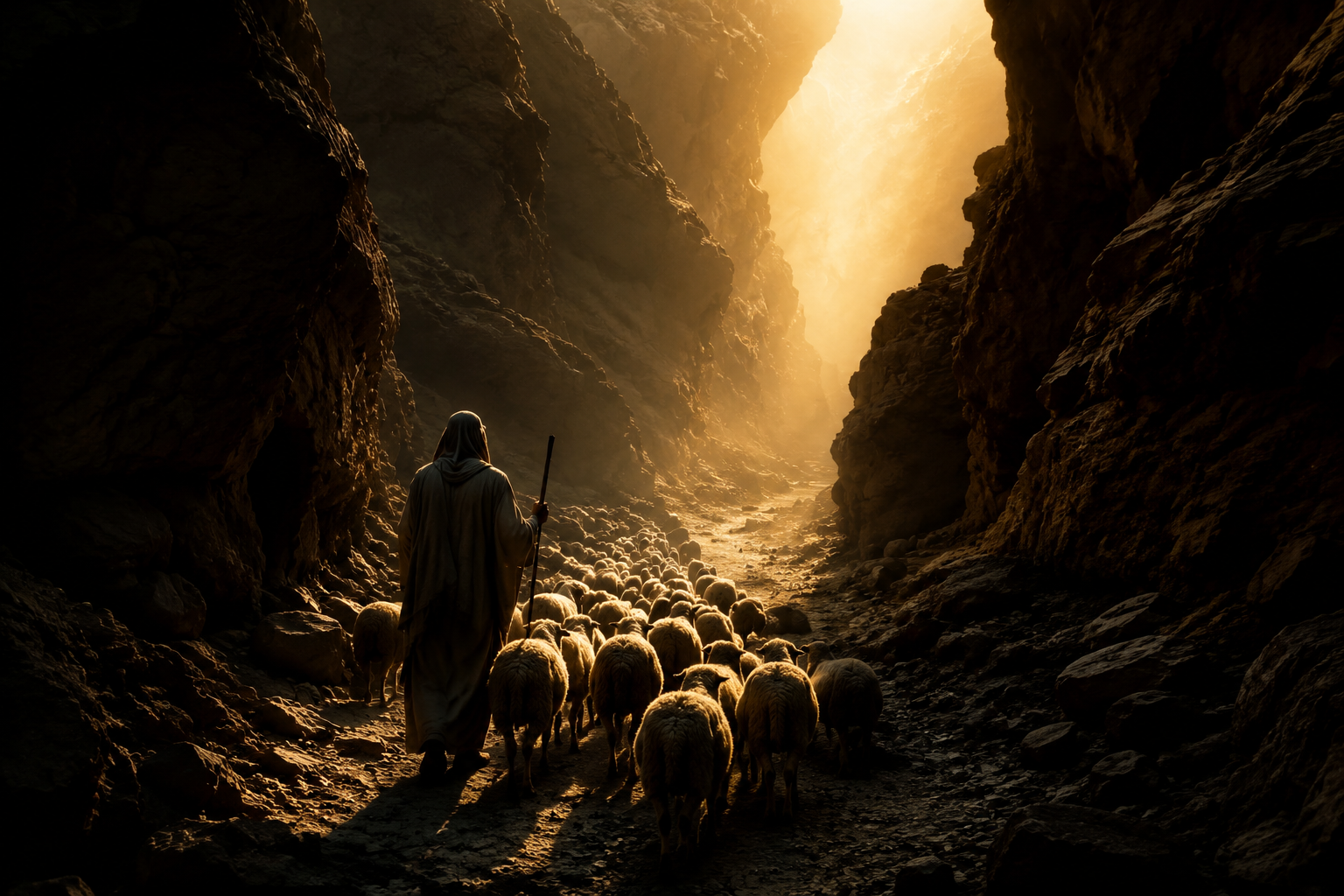
Biblical geographers have identified several wadis (dry valleys) in the Bethlehem and Hebron region matching the description of the ‘valley of the shadow of death’. Those narrow ravines, with high rock walls, stayed in shadow for most of the day and were ideal places for bandit ambushes and predator attacks.
The specific mention of ‘rod and staff’ is not poetic — they are the real working tools that gave the shepherd the ability to defend and rescue his sheep. The rod drove off predators; the staff pulled sheep out of dangerous places.
But why does David move abruptly from dangerous valleys to a table laid out?
Hospitality and divine protection
Verse 5 marks a shift in the metaphor — from shepherd to host:
You prepare a table before me in the presence of my enemies. You anoint my head with oil. My cup runs over. (Psalm 23:5)
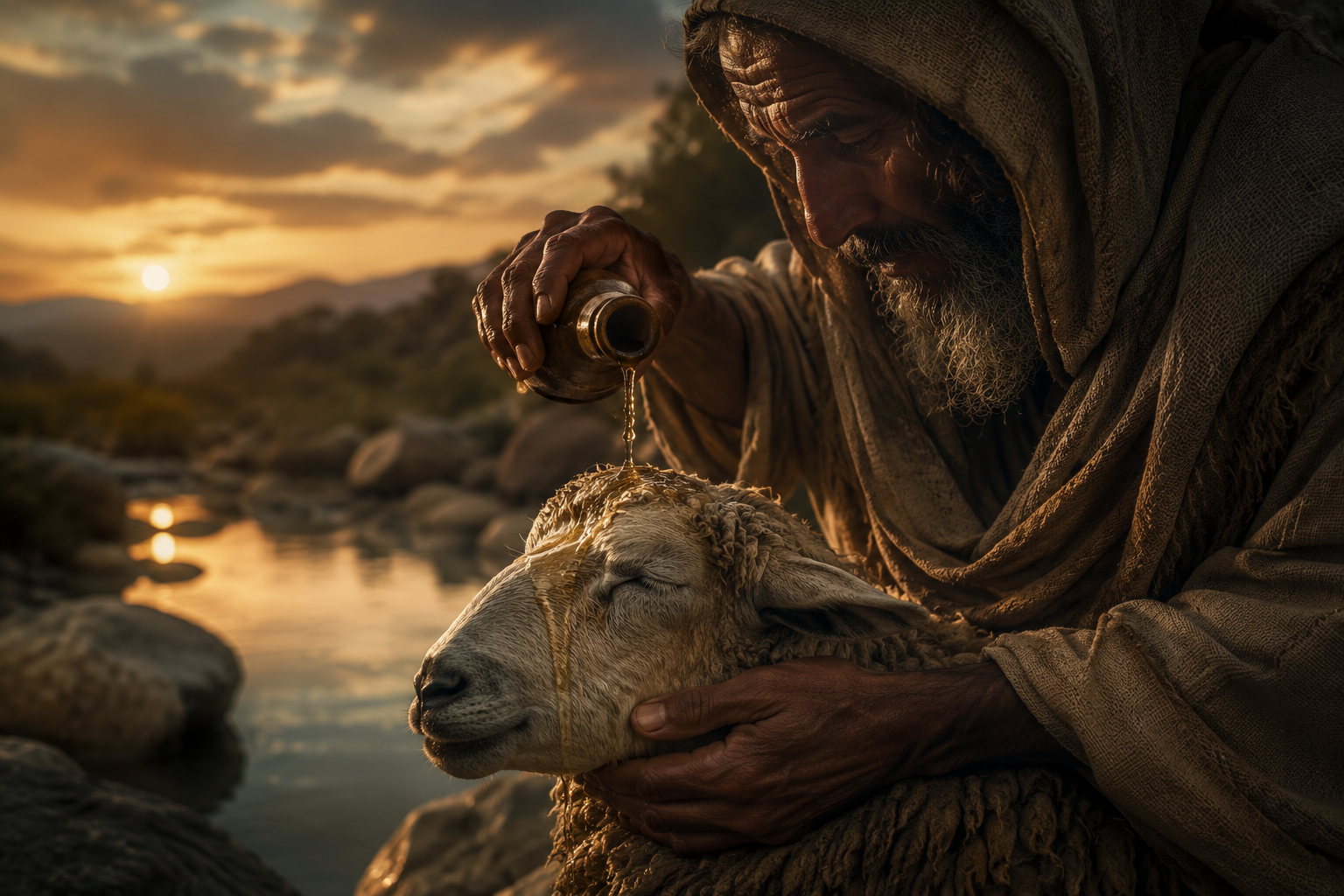
Records from Mari, an ancient Mesopotamian city, describe the custom of anointing a guest’s head with perfumed oil as a sign of honour and protection. Once someone received hospitality, the host became responsible for their safety — even if that meant facing enemies.
The ‘table in the presence of enemies’ was not just generosity, but a public declaration of protection. It was as if God were announcing: ‘This one is under my protection’.
The oil on the head also had a practical function — it protected against insects and the scorching desert sun, showing care for the details of the guest’s wellbeing.
Dwelling for ever: the flock’s final destination
The psalm closes with a statement of confidence that reaches beyond this present life:
Surely goodness and loving kindness shall follow me all the days of my life, and I will dwell in Yahweh’s house forever. (Psalm 23:6)
The Hebrew word ‘radaph’ (to follow) is the same one used to describe military pursuit. David is saying that God’s goodness and mercy ‘pursue’ him with the same intensity with which enemies would pursue his destruction.
‘I will dwell in the house of the Lord’ uses a verb that can mean both ‘to dwell’ and ‘to return’. That suggests not only continuing presence, but the idea of home — a place you can always come back to.
The expression ‘forever’ in Hebrew is ‘le’orekh yamim’ — literally ‘for length of days’, which can refer either to a long life or to eternity.
Psalm 23 today: lessons from an ancient shepherd
Three thousand years after David wrote these words, archaeological discoveries and historical context reveal layers of meaning our modern reading often misses. Psalm 23 is not just a beautiful metaphor — it is the testimony of someone who knew intimately both the dangers of shepherding and the faithfulness of God.
Each verse reveals specific aspects of divine care: provision of basic needs, guidance along safe paths, protection in moments of danger, generous hospitality and the promise of a permanent home. These were not abstract concepts for David, but realities he lived day by day in his youth caring for sheep.
When we face our own ‘valleys of the shadow of death’ — illness, loss, uncertainty or fear — David’s words carry the authority of someone who personally tested the faithfulness of the Supreme Shepherd. And his confidence, forged in the rocky fields of Judea, still offers hope and comfort to everyone who recognises their need of a Shepherd.
The Great Story — 7 free devotionals
If this subject touched you, I put together a free devotional with the most important passages to deepen your Bible reading.