 VIVE O

You learned that Jesus died on Friday and rose on Sunday. And that, between the two, nothing happened — the body in the tomb, the stone in place, and the rest was waiting.
Except that for more than sixteen hundred years the church has repeated a line that does not fit inside that silence: “he descended to Hades”.
And the apostle Peter wrote a sentence almost no preacher dares explain from the pulpit:
“in which he also went and preached to the spirits in prison” (1 Peter 3:19)
If you have ever stalled on that verse and gone back two lines thinking you had skipped something, you were not the first. Nobody skips it. The sentence is there, whole, and it simply goes unexplained.
The Bible states that something happened in that gap. And never says what.
In this article we will walk through every text involved — Peter, Ephesians, Acts, Luke, Matthew — and separate three things that are almost always tangled together: what the Bible states, what it merely suggests, and what is church tradition. By the end you will understand why there are three competing readings of those three days, and why none of them has managed to bury the other two.
Three days the Bible refuses to narrate

Notice what the four gospels do. They describe the arrest hour by hour. The trial. The flogging. The crucifixion in almost clinical detail. The cry. The last breath.
And then they stop.
The next event narrated is already Sunday morning, with the stone rolled away. Between those two points there is a gap of roughly forty hours where the text puts not a single camera.
It is not an oversight. None of the four authors tries to fill it. And yet the New Testament letters keep returning to that gap — sideways, in passing, like someone mentioning something their first readers already knew and did not need explained.
That is where the problem lies: we lost what they had. And we are left with the loose sentences.
The strangest of them is Peter’s.
The sentence nobody explains: “preached to the spirits in prison”
Here is the full context:
“Because Christ also suffered for sins once, the righteous for the unrighteous, that he might bring you to God, being put to death in the flesh, but made alive in the spirit; in which he also went and preached to the spirits in prison, who before were disobedient, when God waited patiently in the days of Noah, while the ship was being built” (1 Peter 3:18-20)
Three details of the original text usually slip past in English.
First: the verb translated “preached” is kēryssō — to proclaim, to announce the way a herald announces the king’s victory. It is not the verb for evangelising, for offering salvation. A herald does not negotiate. He informs.
Second: the word “spirits” (pneumata), used like this, alone and in the plural, almost never means dead human beings in the New Testament. It means angelic beings.
Third: that prison is never described anywhere as the destiny of humanity in general.
What researchers point out is uncomfortable: if Peter were talking about dead people getting a second chance, he picked the strangest possible words to say so.
And then he does something stranger still. He dates the prisoners.
Why does Peter tie all this to the days of Noah?
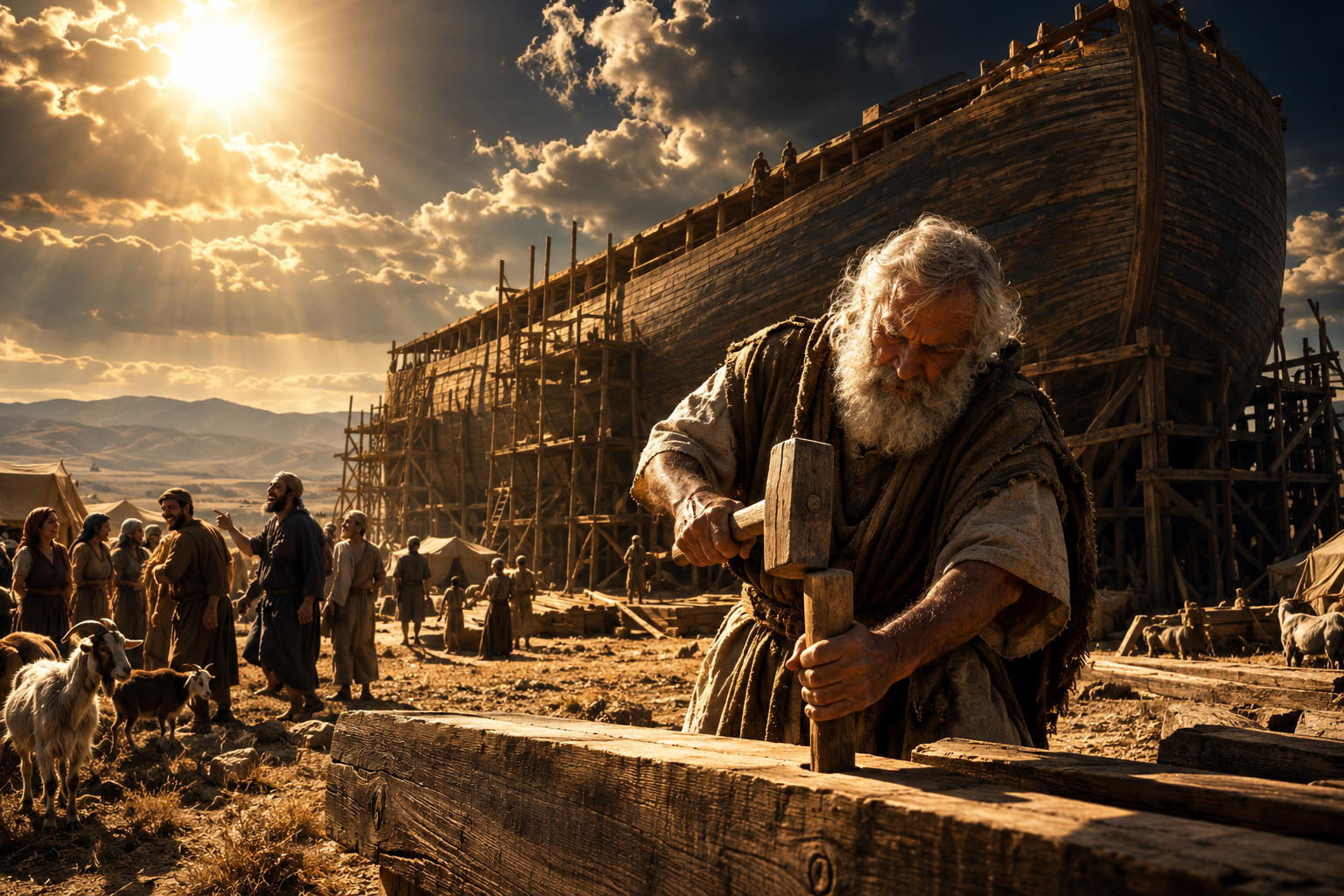
Of all the sinners in history, Peter picks precisely the generation of the flood. Why?
Because for a first-century Jewish reader, “the days of Noah” were not just a date. They were the episode. Genesis 6 opens with four verses most people race past — the “sons of God” who took the daughters of men — and runs straight into the judgement of the waters.
Peter himself returns to it in his second letter:
“For if God didn’t spare angels when they sinned, but cast them down to Tartarus, and committed them to pits of darkness to be reserved for judgment” (2 Peter 2:4)
And Jude, along the same line, speaks of angels “kept in everlasting bonds under darkness for the judgment of the great day” (Jude 6).
Prison. Darkness. Reserved. The same three ideas.
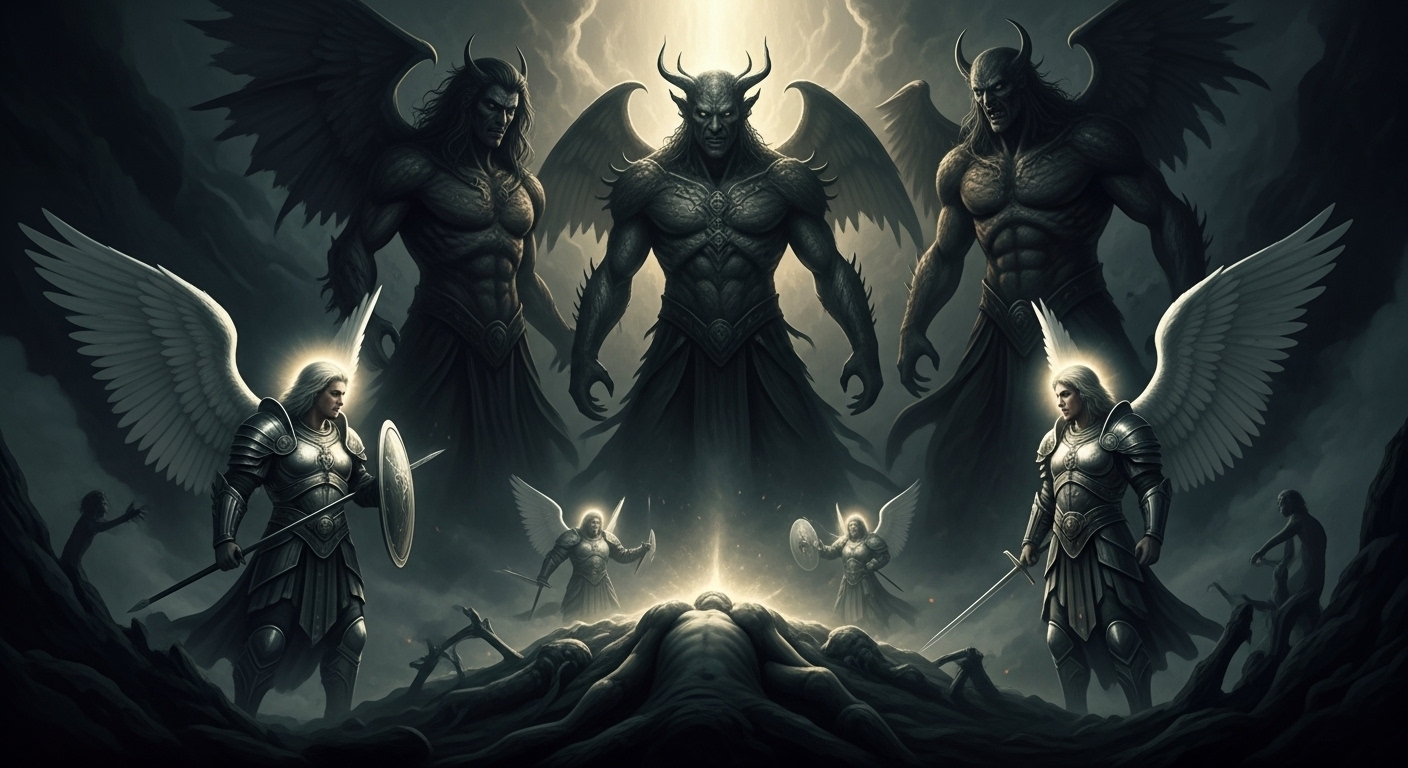
Here comes a historical detail many people do not know: a book called 1 Enoch circulated among the Jews of that era, written centuries before Christ, telling exactly that — rebel angels in chains, and Enoch sent to them to announce there would be no pardon. Peter’s vocabulary and that book’s vocabulary overlap in a way scholars find hard to put down to coincidence. (Full text, public domain: sacred-texts.com/bib/boe/index.htm)
If that reading is right, Jesus did not go down there to convert anyone. He went down to tell the oldest jailers in the world that the war was over.
▶ Watch the full video: “What did Jesus go to do in the place of the dead?”
But if that prison belongs to the angels, one question stays open: what about the dead? Where were they?
Hades is not hell — and that confusion cost dearly
This is where translation hindered more than it helped.
The Old Testament calls the place of the dead Sheol. The New Testament, in Greek, uses Hades. Neither word means the fiery hell of the final judgement — that has another name in the text: Gehenna, and in Revelation, “the lake of fire”.
Sheol and Hades are the state of the dead. The waiting place. Righteous and unrighteous both appear there.
The trouble is that older translations rendered Hades as “hell” in decisive passages:
“because you will not leave my soul in Hades, neither will you allow your Holy One to see decay” (Acts 2:27)
Peter is quoting Psalm 16 and applying it to Jesus. And he adds: “that his soul wasn’t left in Hades, and his flesh didn’t see decay” (Acts 2:31).
Read it without the weight of the word “hell” and the sentence changes colour: his soul was in the place of the dead, and it was not abandoned there. It is a statement about resurrection, not about torment.
And Jesus himself had already described that place as something divided. In Luke 16 the beggar dies and is carried “to Abraham’s bosom”; the rich man dies and lifts up his eyes “in torment”. Between the two:
“Besides all this, between us and you there is a great gulf fixed, that those who want to pass from here to you are not able, and that none may cross over from there to us.” (Luke 16:26)
One domain, two sides, a chasm in the middle. Hold on to that image — it is the key to the next contradiction.
“Today you will be with me in paradise”: the apparent contradiction
On the cross, Jesus promises the criminal beside him:
“Jesus said to him, ‘Assuredly I tell you, today you will be with me in Paradise.'” (Luke 23:43)
Today. Not in three days.
And yet he had said of himself:
“so will the Son of Man be three days and three nights in the heart of the earth” (Matthew 12:40)
How can someone be in paradise and in the heart of the earth at the same time?
There are at least three proposed ways out, and it is honest to say all three are interpretation, not biblical statement.
The first: “paradise” would be precisely the good side of Hades — the bosom of Abraham in Luke 16. In that case there is no contradiction at all; it is the same address under two names.
The second: some translators propose moving the comma — “I tell you today, you will be with me in paradise” — shifting the adverb to the speaking rather than the arriving. It is grammatically possible (ancient Greek had no punctuation), but the overwhelming majority of translators reject the change.
The third: “paradise” would be the presence of God, and the Son would be on both planes because only the body stayed in the tomb.
None of these readings can be proved from the text. But there is one narrative detail, at the exact hour of death, that nobody manages to ignore.
The tombs that opened (Matthew 27)
These are the three strangest verses in the whole passion account:
“Behold, the veil of the temple was torn in two from the top to the bottom. The earth quaked and the rocks were split. The tombs were opened, and many bodies of the saints who had fallen asleep were raised; and coming out of the tombs after his resurrection, they entered into the holy city and appeared to many.” (Matthew 27:51-53)
Look at the seam in the timeline. The tombs open at the hour of death. But the people only come out after his resurrection.
Which means: between the opening and the coming out lies exactly that three-day gap.
Matthew does not explain. No names, no numbers, no return to the subject. He is the only evangelist who records the episode, and he records it like someone noting a fact he does not know where to file.
Some read symbolic language of judgement there. Some read it literally. What is beyond dispute is that, in Matthew’s account, the death of Jesus disturbed the territory of the dead — and his resurrection was the door through which others walked out.
Paul seems to describe the same scene from another angle.
“He led captivity captive” — what Ephesians 4 means
“Therefore he says, ‘When he ascended on high, he led captivity captive, and gave gifts to people.’ Now this, ‘He ascended’, what is it but that he also first descended into the lower parts of the earth?” (Ephesians 4:8-10)
The image is military: a general returning from battle with a line of freed prisoners behind him.
And once again the dispute is a preposition. Do “the lower parts of the earth” mean the lower regions, that is, the earth — so Paul is only talking about the incarnation, about God coming down into our world? Or do they mean the parts beneath the earth, Sheol?
Both translations are grammatically defensible. And it is on exactly that hair’s breadth that the three great readings of history are balanced.
The three readings — and none of them is closed
1. Proclamation of victory
Jesus went down to the place of the dead, but not to save anyone: to announce to the rebel spirits of Noah’s days that their plan had failed. It rests on the verb kēryssō, on 2 Peter 2:4 and on Jude 6. It is the reading that most respects the original vocabulary — and the one that comforts least.
2. Liberation of the righteous
He went down, emptied the “bosom of Abraham” and took with him those who died waiting for the promise. It rests on Ephesians 4:8, on Matthew 27:52-53 and on this verse from Peter:
“For to this end the Good News was preached even to the dead, that they might be judged indeed as men in the flesh, but live as to God in the spirit.” (1 Peter 4:6)
It is the dominant reading in Eastern Christianity and the oldest in Christian art. It is also the one that leans most on imagery and least on grammar.
3. There was no descent at all
The third reading says Christ preached by the Spirit, through Noah, to the people of that generation — who today are “spirits in prison”, but were alive when they heard. The evangelical theologian Wayne Grudem argued this in a well-known article, “He Did Not Descend into Hell: A Plea for Following Scripture Instead of the Apostles’ Creed” (Journal of the Evangelical Theological Society, vol. 34, 1991), available in the ETS public archive: etsjets.org/files/JETS-PDFs/34/34-1/34-1-pp103-113_JETS.pdf
He argues that no biblical text clearly teaches the descent, and that the clause in the creed should simply be dropped.
Three readings. The same verses. No consensus in twenty centuries.
What is text and what is tradition (the part almost nobody separates)
Here we have to be honest, because most of what gets preached about those three days does not come from the Bible.
The scene of bronze gates being broken down, the dialogue with Death, the keys torn from the enemy — none of that is in any book of the New Testament. It comes from a fourth-century apocryphal text, the Gospel of Nicodemus, and from the medieval imagination it fed.
And the creed itself has a curious history. Rufinus of Aquileia, around the year 404, wrote a commentary on the Apostles’ Creed and recorded something revealing: the clause “he descended into hell” existed in the version used in his church — but was absent from the Roman version and from the Eastern churches (text in the Christian Classics Ethereal Library: ccel.org/ccel/schaff/npnf203.toc.html).
In other words: the clause is ancient, it is serious, it was taken up by almost the whole church — but it entered the creed later, and was not there from the start.
That does not make it false. It makes it tradition. And calling tradition tradition is the difference between research and propaganda.
What the Bible states without hesitation
After all the dispute, a core remains that none of the three readings contests.
He really died. He did not faint, did not pretend, did not slip out a side door. He entered the same place every human being enters.
He did not stay there. “You will not leave my soul in Hades” — Sheol received, and had to give back.
And he came out with the keys in his hand:
“and the Living one. I was dead, and behold, I am alive forever and ever. Amen. I have the keys of Death and of Hades.” (Revelation 1:18)
Whoever holds the key is not the prisoner. He owns the door.
Conclusion: the silence that was not empty
The three most silent days in the Bible are not a dead interval. They are the one stretch of the story where the sacred text lowers its voice and leaves the reader outside the door.
We know he went in. We know he came back. And we know he came back with the keys. The rest — the scene, the dialogue, the list of those who walked out with him — are readings, and anyone presenting them as certainty is going beyond what is written.
Perhaps that is the point. That place stopped being the end of the line for those who believe, not because someone explained what happened inside, but because someone went in and came out.
If this subject stirred in you the urge to read the Bible as one whole story — and not as loose verses — that is exactly why the free devotional The Great Story exists: 7 days following the thread that runs from Genesis to Revelation.
And one loose end remains in this article. Those spirits from the days of Noah, the angels in chains, the book first-century Jews were reading and that Peter seems to quote from memory — the Book of Enoch. Why was it left out of the Bible, and why does the New Testament keep echoing it? That is the next point of the investigation.
The Great Story — 7 free devotionals
If this subject touched you, I put together a free devotional with the most important passages to deepen your Bible reading.
I want access now →